From schedules to screens. One operational record.
Aerios connects the operational functions of an airport into a single platform: flight management, resource allocation, passenger information, airside safety and day-to-day operations. Built for airports of all sizes, and built alongside the people who run them.

Three suites, one foundation.
Airport IT stacks in three layers: the operational record, the operations and maintenance work that runs against it, and the airside picture. Most airports buy each from a different vendor. Aerios builds all three on one database, so nothing is re-keyed and every record shares one audit trail.
Aerios AMS
- Airport Operational Database (AODB)
- Resource Management System (RMS)
- Flight Information Display System (FIDS)
Seasonal SSIM planning, active flight and turnaround management, rule-based allocation of gates, stands, counters and belts on a rolling Gantt with conflict detection, and display management for every screen in the terminal plus APIs and an embeddable web widget.
Aerios AMS brochure
Aerios Orbis
- Asset management (CMMS)
- Inspections
- Operations log
- Lost & Found
- Permit management
- Badge management
Asset registry and lifecycle records, preventive maintenance, configurable inspection checklists with mobile forms, shift and occurrence logging with duty handover, and lost property with chain of custody. Permits and badges use the same stakeholder registry AMS already holds.
Aerios Orbis brochure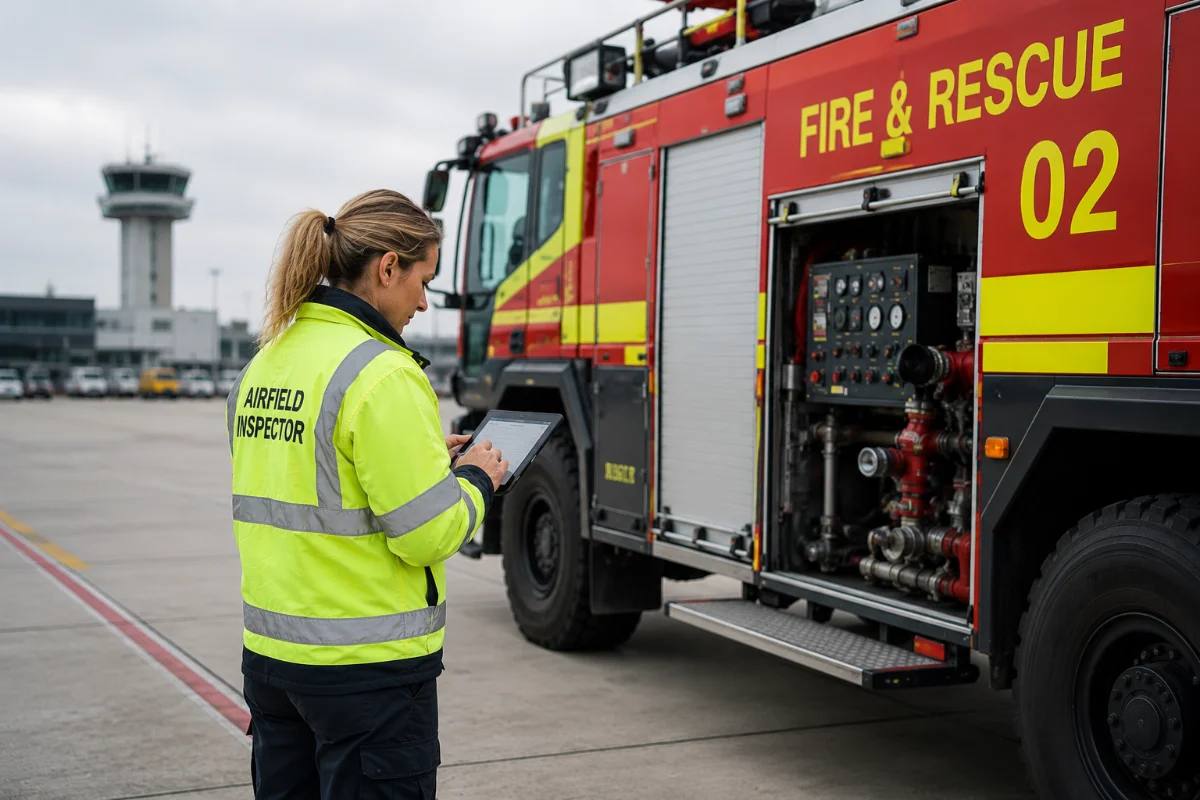
Aerios Vecta
- Aircraft and vehicle tracking
- Safety alerts and event detection
- Geofencing and custom rules
- Blipper tracking hardware
- CCTV, NOTAM and METAR in the same view
- 30-day airside replay
Aircraft via ADS-B and surveillance feeds, vehicles via GNSS, on one airport map. Incursion, speed, dwell-time and boundary alerts with configurable severity, and in-cab warnings from the Blipper retrofit unit at one-second updates and up to 1.5 m accuracy.
Aerios Vecta brochure
Every module sits on the same record.
A permit issued in Orbis references the airline and ground handler already registered in the AODB. An inspection defect raised on the apron becomes a work order without leaving the platform. A stand blocked for maintenance disappears from RMS allocation at the same moment.
That is what we mean by vertically integrated: one identity model, one mobile client, one automation engine and one audit trail, shared rather than duplicated across layers.
Built once. Available in every module.
- Cloud-native architecture
- Role-based access control
- Mobile and tablet support
- QR and barcode scanning
- Notifications and escalations
- Workflow automation
- Document management
- Dashboards and analytics
- Advanced search and filtering
- Complete audit trails
- API integration framework
- Multi-airport deployment
Cloud where it helps. On-premise where it matters.
The central database runs in the cloud so several airports can share one view. A small integration layer sits at each airport so operations keep running when the link doesn't.
Airport Operational Database
The system of record. Dashboards, reporting and the data warehouse for every airport on the network.
Airport Integration Layer
Business rules, validation and message translation. Keeps working through a connectivity drop and syncs when the link returns.
Your existing systems
Baggage handling, displays, public address, ATM automation, reconciliation and A-CDM. We connect to what you have.
Your ops team's software partner, not their vendor.

We start small, on purpose.
Most airports begin with a single module and a single terminal. That first deployment tells both of us whether the fit is right. There's no minimum bundle.
Your people shape the roadmap.
When your AOCC or airside team tells us a workflow is wrong, that goes on the board, not into a backlog nobody reads. The modules we build next are the ones airports ask for.
You get a named engineer, not a ticket queue.
Each airport we work with has one person on our side who knows its layout, its subsystems and its people. That person answers the phone during operations.
Your data is yours.
Per-airport data segregation, and your records are exportable at any time. If you leave, you take everything with you in standard formats.
Built to international regulations. Strict on data privacy and residency.
Aerios follows ICAO and IATA operating standards and the DGCA and CERT-In requirements Indian airports answer to. Your data is segregated per airport, encrypted at rest and in transit, and hosted in the jurisdiction you choose so residency rules are met by design.
Who you'll be dealing with.
Aerios is built by Blunav System Private Ltd, a small team that has spent its careers in airport operations and airport IT.
Close to a quarter century of AODB, RMS and FIDS.
Between us we have spent most of our working lives inside airport operations: running and integrating the operational database, allocating stands and counters under pressure, and keeping display systems honest across a terminal. Aerios is what we wished we'd had.
Small on purpose.
Engineers, aviation operations specialists and airport IT people on one team, with no layer between the person who writes the code and the person who stands in the AOCC. When you call, you reach someone who has done the job.
Tell us about your airport. We'll tell you what fits and what doesn't.
A first conversation takes under an hour. We'll ask about your terminal, your subsystems and what's slowing your ops team down today, then show you a live deployment rather than a slide deck.